Forex trading for beginners starts with market structure, risk limits and a demo account before any real capital
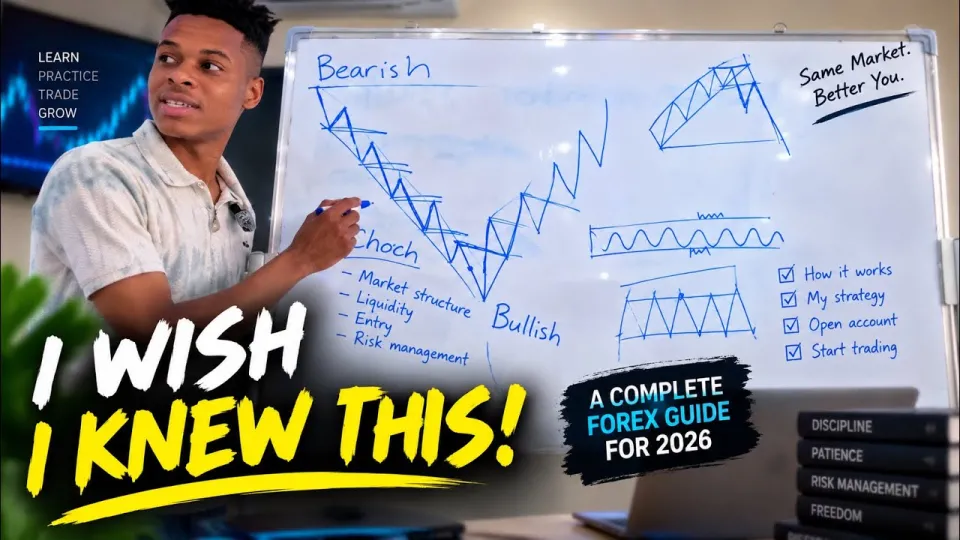
Video: How To Start Forex Trading For Beginners in 2026 (Full Guide + My Strategy)
Need articles like this for your video? They help promote it on YouTube and Google — order them in the Telegram bot @sat_sit_bot. Articles with your video embedded are written and posted by the bot itself — on popular topical sites (no ads). Your first 50 articles are free.
· based on the channel Carl Fx
Forex trading for beginners means learning three things before risking money: how currency pairs are quoted, how to read market structure on a chart, and how to size a position so a single loss cannot damage the account. You can start today with a free demo account, and the first real deposit should come only after a strategy has been tested for dozens of trades. Carl Fx covers exactly this path in his beginner guide, and his sign-up link for opening a trading account with TFC Global Markets is the practical starting point he offers viewers.
What forex trading actually is and how the market is structured
Forex is the market where national currencies are exchanged in pairs, and its price is simply the ratio between two economies at a given moment. Unlike stocks, there is no central exchange: trading happens over the counter between banks, brokers and liquidity providers, which is why spreads differ from broker to broker and why the market runs continuously from Sunday evening to Friday evening (UTC).
The most traded pair, EUR/USD, typically accounts for roughly a fifth of daily turnover, and major pairs such as GBP/USD, USD/JPY and AUD/USD carry the tightest spreads because they are the most liquid. A quote like 1.0850 on EUR/USD means one euro buys 1.0850 US dollars; a standard lot is 100,000 units of the base currency, a mini lot is 10,000 and a micro lot is 1,000. That matters because leverage lets you control a large position with a small deposit, and the same leverage that amplifies gains amplifies losses.
How to open a trading account and what to check first
Opening a trading account takes minutes, but the checks around it decide whether the account survives its first month. The sequence below is the one a beginner should follow, whether the broker is TFC Global Markets or any other regulated venue.
- Verify regulation and client-fund handling — look for a licence number on the regulator's own register, not just on the broker's website.
- Compare costs: spread on EUR/USD, commission per lot, swap rates for holding overnight, and whether deposits or withdrawals carry fees.
- Register, complete identity verification (ID and proof of address), and confirm the base currency of the account.
- Open a demo account first and trade the same strategy you intend to use live.
- Fund only with money you can afford to lose, and start with the smallest position size the platform allows.
Carl Fx discloses in the video description that he owns TFC Global Markets, the brokerage behind the sign-up link — a fact worth weighing against independent reviews before depositing.
Reading bullish and bearish market structure
Market structure is the pattern of swing highs and swing lows that tells you which side controls price. In a bullish market, each rally makes a higher high and each pullback holds above the previous low; in a bearish market, the reverse happens, with lower highs and lower lows. A trend stays valid until that sequence breaks, and the break itself — a lower low inside an uptrend, or a higher high inside a downtrend — is the first signal that control is shifting.
Price action traders mark the last clear swing high and swing low, then wait for price to return to a zone rather than chase a candle mid-move. Support and resistance, supply and demand zones and round numbers all work as reference points, but they only matter when they line up with the structure. On a 4-hour chart, structure tells you direction; on a 15-minute chart, the same idea tells you timing.
A simple beginner strategy built on structure and risk
The strategy that suits a new trader is deliberately boring: trade with the structure, enter on a pullback, and let the stop loss define the position size. A workable version looks like this.
- Identify direction on the higher timeframe (4-hour or daily) from the swing sequence.
- Wait for price to pull back into a zone where the last impulse began.
- Enter after a confirmation candle, with the stop beyond the swing that invalidates the idea.
- Set the target at the next structural level, aiming for at least 1.5 to 2 times the risk.
- Risk no more than 1–2% of equity per trade, so ten consecutive losses cost 10–20%, not the account.
Position size follows from the stop: if the stop is 20 pips away and you risk $20, each pip is worth $1, which on EUR/USD is a 0.10 lot (one mini lot). Beginners who skip this calculation and trade a fixed lot size are the ones whose accounts disappear in a bad week.
Common mistakes and the questions beginners actually ask
Most beginner losses come from behaviour, not from a lack of indicators. The recurring themes in the comments under Carl Fx's guide are telling: people are excited to start immediately, some cannot complete real-account verification, others admit they struggle to grasp the concepts at all, and at least one asks for chart examples. Each of those points to a fixable problem.
- Starting live too early: a demo account is free, and a month of consistent demo results is a better green light than enthusiasm.
- Skipping verification: identity checks are a legal requirement at regulated brokers, so prepare documents before you want to withdraw.
- Learning from videos alone: pause the video, open the same pair, and mark the swings yourself — that is what turns a concept into a skill.
- Overtrading after a win: one good trade is not a system; judge results over 50–100 trades.
- Ignoring the cost of leverage: a 1% move on a 1:100 position is a 100% move on your margin.
Where to practise and what to expect in the first months
Realistic expectations protect beginners better than any indicator. A new trader should plan for several months of demo and small live trading before judging whether the approach works, and should keep a journal of every entry with the reason, the risk and the outcome. Profits are never guaranteed, and the traders who last are the ones who treat the first year as tuition rather than as income.
Useful links
- Open a trading account with TFC Global Markets — the brokerage sign-up link shared by Carl Fx, who discloses ownership of the company.
- Carl Fx free Telegram community — the channel where he shares setups and answers questions.
The takeaway
Forex for beginners is a sequence, not a shortcut: understand how pairs are quoted, open and verify an account, learn to read bullish and bearish structure, and apply one simple strategy with risk capped at 1–2% per trade. Carl Fx builds his full beginner guide around that order and is candid that trading is about discipline and risk management rather than getting rich overnight. Use the demo account until the process feels routine, then start small through TFC Global Markets or any broker you have independently checked. The channel Carl Fx is the author of this breakdown, and its comment section is a useful reality check on how long the learning curve really is.
Key takeaways
- Forex is an over-the-counter market where currencies trade in pairs such as EUR/USD; there is no central exchange and prices move 24 hours a day, five days a week.
- Most brokers let you open a free demo account with virtual funds, so the first weeks of practice cost nothing.
- Market structure is the sequence of higher highs and higher lows (bullish) or lower highs and lower lows (bearish) that defines direction.
- Risk per trade is usually capped at 1–2% of account equity, and position size is calculated from stop distance, not guessed.
- Carl Fx walks through account opening, market structure and a simple price-action strategy in his beginner guide, and discloses that he owns the brokerage he links to.
Source: How To Start Forex Trading For Beginners in 2026 (Full Guide + My Strategy) · Markdown version
Questions & answers
How much money do I need to start forex trading?
You can open a demo account for free and practise indefinitely. When you go live, many brokers accept deposits from $10–$100 on micro accounts, but the more important number is risk per trade: with 1% risk on a $500 account, each trade risks $5, which keeps losses survivable while you learn.
Why can't I open a real account or complete verification?
Regulated brokers require identity verification under anti-money-laundering rules, so you need a valid ID and a proof of address such as a utility bill or bank statement showing your name and address. Blurred photos, mismatched names or expired documents are the usual causes of rejection; support can tell you exactly which document failed.
Do I need indicators to trade forex?
No. Market structure and price action — swing highs, swing lows, support and resistance — are enough to define direction and entries. Indicators such as moving averages or RSI can help confirm a bias, but adding more of them does not fix poor risk management, which is where most beginner losses originate.
How long does it take to become consistently profitable?
Most traders need many months of deliberate practice, and there is no guaranteed timeline. A sensible path is a few months on demo, then small live positions with 1–2% risk per trade, reviewing a journal of at least 50–100 trades before deciding whether the strategy has an edge.